Ahmed Sajjad Hashemy

Israel did 9/11, ALL THE PROOF IN THE WORLD!!!

For the full report visit this website! Make sure to check out this.

CIA Dengue Expirements in Lahore ...

Experts in Pakistan feared that some kind of biological experiment.

MQM Logic Impresses Shopkeepers Discovery!!!

On the morning of 23rd August 2011, shopkeepers nationwide stood outside in awe.

You know you're Zionist when...

You can choose to adopt a different identity and later hijack it.

Energy Crisis in Pakistan ...

Energy is the most important sources for economic growth of a country.

Sunday, October 30, 2011

The Elite Plan for a New World Social Order ...


When the Industrial Revolution began in Britain, in the late 1700s, there was lots of money to be made by investing in factories and mills, by opening up new markets, and by gaining control of sources of raw materials. The folks who had the most money to invest, however, were not so much in Britain but more in Holland. Holland had been the leading Western power in the 1600s, and its bankers were the leading capitalists. In pursuit of profit, Dutch capital flowed to the British stock market, and thus the Dutch funded the rise of Britain, who subsequently eclipsed Holland both economically and geopolitically.

In this way British industrialism came to be dominated by wealthy investors, and capitalism became the dominant economic system. This led to a major social transformation. Britain had been essentially an aristocratic society, dominated by landholding families. As capitalism became dominant economically, capitalists became dominant politically. Tax structures and import-export policies were gradually changed to favour investors over landowners.

It was no longer economically viable to simply maintain an estate in the countryside: one needed to develop it, turn it to more productive use. Victorian dramas are filled with stories of aristocratic families who fall on hard times, and are forced to sell off their properties. For dramatic purposes, this decline is typically attributed to a failure in some character, a weak eldest son perhaps. But in fact the decline of aristocracy was part of a larger social transformation brought on by the rise of capitalism.

The business of the capitalist is the management of capital, and this management is generally handled through the mediation of banks and brokerage houses. It should not be surprising that investment bankers came to occupy the top of the hierarchy of capitalist wealth and power. And in fact, there are a handful of banking families, including the Rothschilds and the Rockefellers, who have come to dominate economic and political affairs in the Western world.

Unlike aristocrats, capitalists are not tied to a place, or to the maintenance of a place. Capital is disloyal and mobile – it flows to where the most growth can be found, as it flowed from Holland to Britain, then from Britain to the USA, and most recently from everywhere to China. Just as a copper mine might be exploited and then abandoned, so under capitalism a whole nation can be exploited and then abandoned, as we see in the rusting industrial areas of America and Britain.

This detachment from place leads to a different kind of geopolitics under capitalism, as compared to aristocracy. A king goes to war when he sees an advantage to his nation in doing so. Historians can ‘explain’ the wars of pre-capitalist days, in terms of the aggrandisement of monarchs and nations.

A capitalist stirs up a war in order to make profits, and in fact our elite banking families have financed both sides of most military conflicts since at least World War 1. Hence historians have a hard time ‘explaining’ World War 1 in terms of national motivations and objectives.

In pre-capitalist days warfare was like chess, each side trying to win. Under capitalism warfare is more like a casino, where the players battle it out as long as they can get credit for more chips, and the real winner always turns out to be the house – the bankers who finance the war and decide who will be the last man standing. Not only are wars the most profitable of all capitalist ventures, but by choosing the winners, and managing the reconstruction, the elite banking families are able, over time, to tune the geopolitical configuration to suit their own interests.

Nations and populations are but pawns in their games. Millions die in wars, infrastructures are destroyed, and while the world mourns, the bankers are counting their winnings and making plans for their postwar reconstruction investments.

From their position of power, as the financiers of governments, the banking elite have over time perfected their methods of control. Staying always behind the scenes, they pull the strings controlling the media, the political parties, the intelligence agencies, the stock markets, and the offices of government. And perhaps their greatest lever of power is their control over currencies. By means of their central-bank scam, they engineer boom and bust cycles, and they print money from nothing and then loan it at interest to governments. The power of the elite banking gang (the ‘banksters’) is both absolute and subtle…
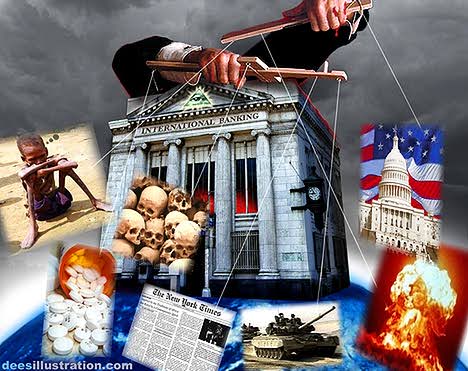
Some of the biggest men in the United States are afraid of something. They know there is a power somewhere, so organised, so subtle, so watchful, so interlocked, so complete, so pervasive that they had better not speak above their breath when they speak in condemnation of it. – President Woodrow Wilson


The End of Growth – Banksters vs. Capitalism

It was always inevitable, on a finite planet, that there would be a limit to economic growth. Industrialisation has enabled us to rush headlong toward that limit over the past two centuries. Production has become ever more efficient, markets have become ever more global, and finally the paradigm of perpetual growth has reached the point of diminishing returns.

Indeed, that point was actually reached by about 1970. Since then capital has not so much sought growth through increased production, but rather by extracting greater returns from relatively flat production levels. Hence globalisation, which moved production to low-waged areas, providing greater profit margins. Hence privatisation, which transfers revenue streams to investors that formerly went to national treasuries. Hence derivative and currency markets, which create the electronic illusion of economic growth, without actually producing anything in the real world.

For almost forty years, the capitalist system was kept going by these various mechanisms, none of which were productive in any real sense. And then in September 2008 this house of cards collapsed, all of a sudden, bringing the global financial system to its knees.

If one studies the collapse of civilisations, one learns that failure-to-adapt is fatal. Is our civilisation falling into that trap? We had two centuries of real growth, where the growth-dynamic of capitalism was in harmony with the reality of industrial growth. Then we had four decades of artificial growth – capitalism being sustained by a house of cards. And now, after the house of cards has collapsed, every effort is apparently being made to bring about ‘a recovery’ – of growth! It is very easy to get the impression that our civilisation is in the process of collapse, based on the failure-to-adapt principle.

Such an impression would be partly right and partly wrong. In order to understand the real situation we need to make a clear distinction between the capitalist elite and capitalism itself. Capitalism is an economic system driven by growth; the capitalist elite are the folks who have managed to gain control of the Western world while capitalism has operated over the past two centuries. The capitalist system is past its sell-by date, the bankster elite are well aware of that fact – and they are adapting.

Capitalism is a vehicle that helped bring the banksters to absolute power, but they have no more loyalty to that system than they have to place, or to anything or anyone. As mentioned earlier, they think on a global scale, with nations and populations as pawns. They define what money is and they issue it, just like the banker in a game of Monopoly. They can also make up a new game with a new kind of money. They have long outgrown any need to rely on any particular economic system in order to maintain their power. Capitalism was handy in an era of rapid growth. For an era of non-growth, a different game is being prepared.

Thus, capitalism was not allowed to die a natural death. Instead it was brought down by a controlled demolition. First it was put on a life-support system, as mentioned above, with globalisation, privatisation, currency markets, etc. Then it was injected with a euthanasia death-drug, in the form of real-estate bubbles and toxic derivatives. Finally, the Bank of International Settlements in Basel – the central bank of central banks – pulled the plug on the life-support system: they declared the ‘mark-to-market rule’, which made all the risk-holding banks instantly insolvent, although it took a while for this to become apparent. Every step in this process was carefully planned and managed by the central-banking clique.

The End of Sovereignty – Restoring the Ancien Régime

Just as the financial collapse was carefully managed, so was the post-collapse scenario, with its suicidal bailout programs. National budgets were already stretched; they certainly did not have reserves available to salvage the insolvent banks. Thus the bailout commitments amounted to nothing more than the taking on of astronomical new debts by governments. In order to service the bailout commitments, the money would need to be borrowed from the same financial system that was being bailed out!

It’s not that the banks were too big to fail, rather the banksters were too powerful to fail: they made politicians an offer they couldn’t refuse. In the USA, Congress was told that without bailouts there would be martial law the next morning. In Ireland, the Ministers were told there would be financial chaos and rioting in the streets. In fact, as Iceland demonstrated, the sensible way to deal with the insolvent banks was with an orderly process of receivership.

The effect of the coerced bailouts was to transfer insolvency from the banks to the national treasuries. Banking debts were transformed into sovereign debts and budget deficits. Now, quite predictably, it is the nations that are seeking bailouts, and those bailouts come with conditions attached. Instead of the banks going into receivership, the nations are going into receivership.

In his book, Confessions of an Economic Hit Man, John Perkins explains how the third world has been coerced over the past several decades – through pressure and trickery of various kinds – into perpetual debt bondage. By design, the debts can never be repaid. Instead, the debts must be periodically refinanced, and each round of refinancing buries the nation deeper in debt – and compels the nation to submit to even more drastic IMF diktats. With the orchestrated financial collapse, and the ‘too big to fail’ scam, the banksters have now crossed the Rubicon: the hit-man agenda is now operating here in the first world.
In the EU, the first round of nations to go down will be the so-called PIGS – Portugal, Ireland, Greece, and Spain. The fiction, that the PIGS can deal with the bailouts, is based on the assumption that the era of limitless growth will resume. As the banksters themselves know full well, that just isn’t going to happen. Eventually the PIGS will be forced to default, and then the rest of the EU will go down as well, all part of a controlled-demolition project.

When a nation succumbs to debt bondage, it ceases to be a sovereign nation, governed by some kind of internal political process. Instead it comes under the control of IMF diktats. As we have seen in the third world, and is happening now in Europe, these diktats are all about austerity and privatisation. Government functions are eliminated or privatised, and national assets are sold off. Little by little – again a controlled demolition – the nation state is dismantled. In the end, the primary functions left to government are police suppression of its own population, and the collection of taxes to be handed over to the banksters.

In fact, the dismantling of the nation state began long before the financial collapse of 2008. In the USA and Britain, it began in 1980, with Reagan and Thatcher. In Europe, it began in 1988, with the Maastricht Treaty. Globalisation accelerated the dismantling process, with the exporting of jobs and industry, privatisation programs, ‘free trade’ agreements, and the establishment of the regulation-busting World Trade Organisation (WTO). Events since 2008 have enabled the rapid acceleration of a process that was already well underway.

With the collapse, the bailouts, and the total failure to pursue any kind of effective recovery program, the signals are very clear: the system will be allowed to collapse totally, thus clearing the ground for a pre-architected ‘solution’. As the nation state is being dismantled, a new regime of global governance is being established to replace it. As we can see with the WTO, IMF, World Bank, and the other pieces of the embryonic world government, the new global system will make no pretensions about popular representation or democratic process. Rule will be by means of autocratic global bureaucracies, which will take their orders, directly or indirectly, from the bankster clique.

In his book, The Globalization of PovertyMichel Chossudovsky explains how globalisation, and the actions of the IMF, created massive poverty throughout the third world over the past several decades. As we can see, with the dramatic emphasis on austerity following the collapse and bailouts, this poverty-creation project has now crossed the Rubicon. In this new world system there will be no prosperous middle class. Indeed, the new regime will very much resemble the old days of royalty and serfdom (the ancien régime). The banksters are the new royal family, with the whole world as their dominion. The technocrats who run the global bureaucracies, and the mandarins who pose as politicians in the residual nations, are the privileged upper class. The rest of us, the overwhelming majority, will find ourselves in the role of impoverished serfs – if we are lucky enough to be one of the survivors of the collapse process.

Today Americans would be outraged if UN troops entered Los Angeles to restore order; tomorrow they will be grateful. This is especially true if they were told there was an outside threat from beyond, whether real or promulgated, that threatened our very existence. It is then that all peoples of the world will plead with world leaders to deliver them from this evil. The one thing every man fears is the unknown. When presented with this scenario, individual rights will be willingly relinquished for the guarantee of their well being granted to them by their world government. – Henry Kissinger speaking at Evian, France, May 21, 1992 Bilderbergers meeting

The End of Liberty – The Global Police State

For the past four decades, since about 1970, we’ve been experiencing a regime-change process, from an oldglobal system to a new global system. In the old system, first world nations were relatively democratic and prosperous, while the third world suffered under police state tyranny, mass poverty, and imperialism (exploitation by external powers). As discussed above, the transition process has been characterised by ‘crossing the Rubicon’ – the introduction of policies and practices into the first world, that were formerly limited, for the most part, to the third world.

Thus debt bondage to the IMF crossed the Rubicon, enabled by the collapse-bailout scam. In turn, mass poverty is crossing that same Rubicon, due to austerity measures imposed by the IMF, with its new bond-holding powers. Imperialism is also crossing the Rubicon, as the first world comes under the exploitative control of banksters and their bureaucracies, a power nexus that is external to all national identities. Unsurprisingly, police state tyranny is also crossing the Rubicon: the imposition of third world poverty levels requires third world methods of repression.

The anti-globalisation movement can be taken as the beginning of popular resistance to the process ofregime change. Similarly, the police response to the Seattle anti-globalisation demonstrations, in November 1999, can be taken as the ‘crossing of the Rubicon’ for police state tyranny. The excessive and arbitrary violence of that response – including such things as holding people’s eyes open and spraying pepper into them – was unprecedented against non-violent demonstrators in a first world nation.

Ironically, that police response, particularly as it was so widely publicised, actually strengthened the anti-globalisation movement. As demonstrations grew in size and strength, the police response grew still more violent. A climax of sorts was reached in Genoa, in July 2001, when the levels of violence on both sides began to resemble almost a guerilla war.

In those days the anti-globalisation movement was dominating the international news pages, and opposition to globalisation was reaching massive proportions. The visible movement was only the tip of an anti-systemic iceberg. In a very real sense, general popular sentiment in the first world was beginning to take a radical turn. Movement leaders were now thinking in terms of an anti-capitalist movement. There was a political volatility in the air, a sense that, just maybe possibly, enlightened popular sentiment might succeed in shifting the course of events.

All of that changed on September 11, 2001, the day the towers came down. The anti-globalisation movement, along with globalisation itself, disappeared almost totally from public consciousness on that fateful day. Suddenly it was a whole new global scenario, a whole new media circus – with a new enemy, and a new kind of war, a war without end, a war against phantoms, a war against ‘terrorism’.

Earlier we saw how the orchestrated financial collapse of September 2008 enabled certain ongoing projects to be rapidly accelerated, such as the dismantlement of sovereignty, and the imposition of austerity. Similarly, the events of September 2001 enabled certain ongoing projects to be greatly accelerated, such as the abandonment of civil liberties and international law.

Before the towers had even come down, the ‘Patriot Act’ had already been drafted, proclaiming in no uncertain terms that the police state was here (in the USA) in force and here to stay – the Bill of Rights was null and void. Before long, similar ‘anti-terrorist’ legislation had been adopted throughout the first world. If any anti-systemic movement were to again raise its head in the first world (as it did, for example, recently in Greece), arbitrary police powers could be brought to bear – as much as might be necessary – to put the resistancedown. No popular movement would be allowed to derail the banksters’ regime-change designs. The anti-globalisation movement had been shouting, ‘This is what real democracy looks like’. With 9/11, the banksters replied: ‘This is what real oppression looks like’.

The events of 9/11 led directly to the invasions of Iraq and Afghanistan, and in general helped create a climate where invasions of sovereign nations could be readily justified, with one excuse or another. International law was to be as thoroughly abandoned as was civil liberties. Just as all restraint was removed from domestic police interventions, so was all restraint being removed from geopolitical military interventions. Nothing was to stand in the way of the banksters’ regime-change agenda.

The technetronic era involves the gradual appearance of a more controlled society… dominated by an elite, unrestrained by traditional values… this elite would not hesitate to achieve its political ends by using the latest modern techniques for influencing public behaviour… Persisting social crisis, the emergence of a charismatic personality, and the exploitation of mass media to obtain public confidence would be the stepping-stones in the piecemeal transformation of the United States into a highly controlled society… In addition, it may be possible – and tempting – to exploit for strategic political purposes the fruits of research on the brain and on human behaviour. – Zbigniew BrzezinskiBetween Two Ages: America’s Role in the Technetronic Era, 1970

The Post-Capitalist Era – New Myths for a New Culture

2012 might not be the exact year, but it’s difficult to see the endgame lasting much beyond that – and the masters of the universe love symbolism, as with 911 (both in Chile and in Manhattan), KLA 007, and others. 2012 is loaded with symbolism, eg. the Mayan Calendar, and the Internet is buzzing with various 2012-related prophecies, survival strategies, anticipated alien interventions, etc. And then there is the Hollywood film, 2012, which explicitly portrays the demise of most of humanity, and the pre-planned salvation of a select few. One never knows with Hollywood productions, what is escapist fantasy, and what is aimed at preparing the public mind symbolically for what is to come.

Whatever the exact date, all the threads will come together, geopolitically and domestically, and the world will change. It will be a new era, just as capitalism was a new era after aristocracy, and the Dark Ages followed the era of the Roman Empire. Each era has its own structure, its own economics, its own social forms, and its own mythology. These things must relate to one another coherently, and their nature follows from the fundamental power relationships and economic circumstances of the system.

Whenever there is a change of era, the previous era is always demonised in a new mythology. In the Garden of Eden story the serpent is demonised – a revered symbol in paganism, the predecessor to monotheism. With the rise of European nation states, the Catholic Church was demonised, and Protestantism introduced. When republics came along, the demonisation of monarchs was an important part of the process. In the post-2012 world, democracy and national sovereignty will be demonised. This will be very important, in getting people to accept arbitrary totalitarian rule…

In those terrible dark days, before the blessed unification of humanity, anarchy reigned in the world. One nation would attack another, no better than predators in the wild. Nations had no long-term coherence; voters would swing from one party to another, keeping governments always in transition and confusion. How did anyone ever think that masses of semi-educated people could govern themselves, and run a complex society? Democracy was an ill-conceived experiment that led only to corruption and chaotic governance. How lucky we are to be in this well-ordered world, where humanity has finally grown up, and those with the best expertise make the decisions for the whole globe.

Capitalism is about growth, progress, and change. Under capitalism the virtues of ambition, initiative, and competitiveness are praised, because those virtues serve the dynamics of capitalism. People are encouraged to always accumulate more, and never be satisfied with what they have. Under capitalism, people need to have a bit of liberty, and a bit of prosperity, so that the dynamics of capitalism can operate. Without some liberty, ambition cannot be pursued; without some prosperity, how could accumulation be pursued? In the post-capitalist world, the capitalist virtues will be demonised. This will be very important, in getting people to accept poverty and regimentation…

The pursuit of money is the root of all evil, and the capitalist system was inherently corrupt and wasteful. Anarchy reined in the marketplace, as corporations blindly pursued profit, with no concern for human needs or for the Earth. How much more sensible are our production brigades, producing only what is needed, and using only what is sustainable. Capitalism encouraged greed and consumption; people struggled to compete with one another, to ‘get ahead’ in the rat race. How much wiser we are now, to live within our ration quotas, and to accept our assigned duties, whatever they might be, in service to humanity.

In this regime change, ushering in the post-capitalist era, we’re seeing a conscious orchestration of economics, politics, geopolitics, and mythology – as one coordinated project. A whole new reality is being created, a whole new global culture. When it comes down to it, the ability to transform culture is the ultimate form of power. In only a single generation, a new culture becomes ‘the way things are’. And what, we might inquire, might stand in the way of any future manipulations of the cultural regime that the bankster royal family might contemplate?

Ever since public education was introduced, the state and the family have competed to control childhood conditioning – and it is in childhood that culture is transmitted to the next generation. In the micromanaged post-capitalist future, we’ll most likely see the ‘final solution’ of social control, which is for the state to monopolise child raising. This would eliminate from society the parent-child bond, and hence family-related bonds in general. No longer is there a concept of relatives, just fellow members of the hive. The family must be demonised. Already, here in Ireland, there are daily TV spots dramatising the plight of children who are being abused or neglected by their parents…

How scary were the old days, when unlicensed, untrained couples had total control over vulnerable children, behind closed doors, with whatever neuroses, addictions, or perversions the parents happened to possess. How did this vestige of patriarchal slavery, this safe-house den of child abuse, continue so long to exist, and not be recognised for what it was? How much better off we are now, with children being raised scientifically, by trained staff, where they are taught discipline and healthy values. 
The above article appeared in New Dawn No. 128 (September-October 2011).

RIchard K Moore, an expatriate from Silicon Valley, retired and moved to Ireland in 1994 to begin his ‘real work’ – trying to understand how the world works, and how we can make it better. Many years of researching and writing culminated in his widely acclaimed book Escaping the Matrix: How We the People Can Change the World (The Cyberjournal Project, 2005). His cyberjournal email list has been going since 1994 (cyberjournal.org). The book’s website is http://escapingthematrix.org, while his website http://quaylargo.com/rkm/ contains an extensive biography plus list of his articles. Richard can be contacted via email at rkm@quaylargo.com. This article appears in New Dawn 128: www.newdawnmagazine.com.

John F. Kennedy vs The Federal Reserve ...


On June 4, 1963, a virtually unknown Presidential decree, Executive Order 11110, was signed with the authority to basically strip the Bank of its power to loan money to the United States Federal Government at interest. With the stroke of a pen, President Kennedy declared that the privately owned Federal Reserve Bank would soon be out of business. The Christian Law Fellowship has exhaustively researched this matter through the Federal Register and Library of Congress. We can now safely conclude that this Executive Order has never been repealed, amended, or superceded by any subsequent Executive Order. In simple terms, it is still valid.
When President John Fitzgerald Kennedy – the author of Profiles in Courage -signed this Order, it returned to the federal government, specifically the Treasury Department, the Constitutional power to create and issue currency -money – without going through the privately owned Federal Reserve Bank. President Kennedy’s Executive Order 11110 [the full text is displayed further below] gave the Treasury Department the explicit authority: “to issue silver certificates against any silver bullion,silver, or standard silver dollars in the Treasury.” This means that for every ounce of silver in the U.S. Treasury’s vault, the government could introduce new money into circulation based on the silver bullion physically held there. As a result, more than $4 billion in United States Notes were brought into circulation in $2 and $5 denominations. $10 and $20 United States Notes were never circulated but were being printed by the Treasury Department when Kennedy was assassinated. It appears obvious that President Kennedy knew the Federal Reserve Notes being used as the purported legal currency were contrary to the Constitution of the United States of America.
“United States Notes” were issued as an interest-free and debt-free currency backed by silver reserves in the U.S. Treasury. We compared a “Federal Reserve Note” issued from the privatecentral bank of the United States (the Federal Reserve Bank a/k/a Federal Reserve System), with a “United States Note” from the U.S. Treasury issued by President Kennedy’s Executive Order. They almost look alike, except one says “Federal Reserve Note” on the top while the other says “United States Note”. Also, the Federal Reserve Note has a green seal and serial number while the United States Note has a red seal and serial number.
President Kennedy was assassinated on November 22, 1963 and the United States Notes he had issued were immediately taken out of circulation. Federal Reserve Notes continued to serve as the legal currency of the nation. According to the United States Secret Service, 99% of all U.S. paper “currency” circulating in 1999 are Federal Reserve Notes.
Kennedy knew that if the silver-backed United States Notes were widely circulated, they would have eliminated the demand for Federal Reserve Notes. This is a very simple matter of economics. The USN was backed by silver and the FRN was not backed by anything of intrinsic value. Executive Order 11110 should have prevented the national debt from reaching its current level (virtually all of the nearly $9 trillion in federal debt has been created since 1963) if LBJ or any subsequent President were to enforce it. It would have almost immediately given the U.S. Government the ability to repay its debt without going to the private Federal Reserve Banks and being charged interest to create new “money”. Executive Order 11110 gave the U.S.A. the ability to, once again, create its own money backed by silver and realm value worth something.
Again, according to our own research, just five months after Kennedy was assassinated, no more of the Series 1958 “Silver Certificates” were issued either, and they were subsequently removed from circulation. Perhaps the assassination of JFK was a warning to all future presidents not to interfere with the private Federal Reserve’s control over the creation of money. It seems very apparent that President Kennedy challenged the “powers that exist behind U.S. and world finance”. With true patriotic courage, JFK boldly faced the two most successful vehicles that have ever been used to drive up debt:
1) war (Viet Nam); and,
2) the creation of money by a privately owned central bank. His efforts to have all U.S. troops out of Vietnam by 1965 combined with Executive Order 11110 would have destroyed the profits and control of the private Federal Reserve Bank.
Executive Order 11110
AMENDMENT OF EXECUTIVE ORDER NO. 10289 AS AMENDED, RELATING TO THE PERFORMANCE OF CERTAIN FUNCTIONS AFFECTING THE DEPARTMENT OF THE TREASURY. By virtue of the authority vested in me by section 301 of title 3 of the United States Code, it is ordered as follows:
SECTION 1. Executive Order No. 10289 of September 19, 1951, as amended, is hereby further amended – (a) By adding at the end of paragraph 1 thereof the following subparagraph (j): “(j) The authority vested in the President by paragraph (b) of section 43 of the Act of May 12, 1933, as amended (31 U.S.C. 821 (b)), to issue silver certificates against any silver bullion, silver, or standard silver dollars in the Treasury not then held for redemption of any outstanding silver certificates, to prescribe the denominations of such silver certificates, and to coin standard silver dollars and subsidiary silver currency for their redemption,” and (b) By revoking subparagraphs (b) and (c) of paragraph 2 thereof. SECTION 2. The amendment made by this Order shall not affect any act done, or any right accruing or accrued or any suit or proceeding had or commenced in any civil or criminal cause prior to the date of this Order but all such liabilities shall continue and may be enforced as if said amendments had not been made.
JOHN F. KENNEDY THE WHITE HOUSE, June 4, 1963
Once again, Executive Order 11110 is still valid. According to Title 3, United States Code, Section 301 dated January 26, 1998:
Executive Order (EO) 10289 dated Sept. 17, 1951, 16 F.R. 9499, was as amended by:
EO 10583, dated December 18, 1954, 19 F.R. 8725;
EO 10882 dated July 18, 1960, 25 F.R. 6869;
EO 11110 dated June 4, 1963, 28 F.R. 5605;
EO 11825 dated December 31, 1974, 40 F.R. 1003;
EO 12608 dated September 9, 1987, 52 F.R. 34617
The 1974 and 1987 amendments, added after Kennedy’s 1963 amendment, did not change or alter any part of Kennedy’s EO 11110. A search of Clinton’s 1998 and 1999 EO’s and Presidential Directives has also shown no reference to any alterations, suspensions, or changes to EO 11110.
The Federal Reserve Bank, a.k.a Federal Reserve System, is a Private Corporation. Black’s Law Dictionary defines the “Federal Reserve System” as: “Network of twelve central banks to which most national banks belong and to which state chartered banks may belong. Membership rules require investment of stock and minimum reserves.” Privately-owned banks own the stock of the FED. This was explained in more detail in the case of Lewis v. United States, Federal Reporter, 2nd Series, Vol. 680, Pages 1239, 1241 (1982), where the court said: “Each Federal Reserve Bank is a separate corporation owned by commercial banks in its region. The stock-holding commercial banks elect two thirds of each Bank’s nine member board of directors”.
The Federal Reserve Banks are locally controlled by their member banks. Once again, according to Black’s Law Dictionary, we find that these privately owned banks actually issue money:
“Federal Reserve Act. Law which created Federal Reserve banks which act as agents in maintaining money reserves, issuing money in the form of bank notes, lending money to banks, and supervising banks. Administered by Federal Reserve Board (q.v.)”.
The privately owned Federal Reserve (FED) banks actually issue (create) the “money” we use. In 1964, the House Committee on Banking and Currency, Subcommittee on Domestic Finance, at the second session of the 88th Congress, put out a study entitled Money Facts which contains a good description of what the FED is: “The Federal Reserve is a total money-making machine. It can issue money or checks. And it never has a problem of making its checks good because it can obtain the $5 and $10 bills necessary to cover its check simply by asking the Treasury Department’s Bureau of Engraving to print them”.
Any one person or any closely knit group who has a lot of money has a lot of power. Now imagine a group of people who have the power to create money. Imagine the power these people would have. This is exactly what the privately owned FED is!
No man did more to expose the power of the FED than Louis T. McFadden, who was the Chairman of the House Banking Committee back in the 1930s. In describing the FED, he remarked in the Congressional Record, House pages 1295 and 1296 on June 10, 1932:
“Mr. Chairman, we have in this country one of the most corrupt institutions the world has ever known. I refer to the Federal Reserve Board and the Federal reserve banks. The Federal Reserve Board, a Government Board, has cheated the Government of the United States and he people of the United States out of enough money to pay the national debt. The depredations and the iniquities of the Federal Reserve Board and the Federal reserve banks acting together have cost this country enough money to pay the national debt several times over. This evil institution has impoverished and ruined the people of the United States; has bankrupted itself, and has practically bankrupted our Government. It has done this through the maladministration of that law by which the Federal Reserve Board, and through the corrupt practices of the moneyed vultures who control it”.
Some people think the Federal Reserve Banks are United States Government institutions. They are not Government institutions, departments, or agencies. They are private credit monopolies which prey upon the people of the United States for the benefit of themselves and their foreign customers. Those 12 private credit monopolies were deceitfully placed upon this country by bankers who came here from Europe and who repaid us for our hospitality by undermining our American institutions.
The FED basically works like this: The government granted its power to create money to the FED banks. They create money, then loan it back to the government charging interest. The government levies income taxes to pay the interest on the debt. On this point, it’s interesting to note that the Federal Reserve Act and the sixteenth amendment, which gave congress the power to collect income taxes, were both passed in 1913. The incredible power of the FED over the economy is universally admitted. Some people, especially in the banking and academic communities, even support it. On the other hand, there are those, such as President John Fitzgerald Kennedy, that have spoken out against it. His efforts were spoken about in Jim Marrs’ 1990 book Crossfire:”
Another overlooked aspect of Kennedy’s attempt to reform American society involves money. Kennedy apparently reasoned that by returning to the constitution, which states that only Congress shall coin and regulate money, the soaring national debt could be reduced by not paying interest to the bankers of the Federal Reserve System, who print paper money then loan it to the government at interest. He moved in this area on June 4, 1963, by signing Executive Order 11110 which called for the issuance of $4,292,893,815 in United States Notes through the U.S. Treasury rather than the traditional Federal Reserve System. That same day, Kennedy signed a bill changing the backing of one and two dollar bills from silver to gold, adding strength to the weakened U.S. currency.
Kennedy’s comptroller of the currency, James J. Saxon, had been at odds with the powerful Federal Reserve Board for some time, encouraging broader investment and lending powers for banks that were not part of the Federal Reserve system. Saxon also had decided that non-Reserve banks could underwrite state and local general obligation bonds, again weakening the dominant Federal Reserve banks”.
In a comment made to a Columbia University class on Nov. 12, 1963,
Ten days before his assassination, President John Fitzgerald Kennedy allegedly said:
“The high office of the President has been used to foment a plot to destroy the American’s freedom and before I leave office, I must inform the citizen of this plight.”
In this matter, John Fitzgerald Kennedy appears to be the subject of his own book… a true Profile of Courage.
This research report was compiled for Lawgiver. Org. by Anthony Wayne
What is the Federal Reserve Bank?
What is the Federal Reserve Bank (FED) and why do we have it?
by Greg Hobbs November 1, 1999
The FED is a central bank. Central banks are supposed to implement a country’s fiscal policies. They monitor commercial banks to ensure that they maintain sufficient assets, like cash, so as to remain solvent and stable. Central banks also do business, such as currency exchanges and gold transactions, with other central banks. In theory, a central bank should be good for a country, and they might be if it wasn’t for the fact that they are not owned or controlled by the government of the country they are serving. Private central banks, including our FED, operate not in the interest of the public good but for profit.
There have been three central banks in our nation’s history. The first two, while deceptive and fraudulent, pale in comparison to the scope and size of the fraud being perpetrated by our current FED. What they all have in common is an insidious practice known as “fractional banking.”
Fractional banking or fractional lending is the ability to create money from nothing, lend it to the government or someone else and charge interest to boot. The practice evolved before banks existed. Goldsmiths rented out space in their vaults to individuals and merchants for storage of their gold or silver. The goldsmiths gave these “depositors” a certificate that showed the amount of gold stored. These certificates were then used to conduct business.
In time the goldsmiths noticed that the gold in their vaults was rarely withdrawn. Small amounts would move in and out but the large majority never moved. Sensing a profit opportunity, the goldsmiths issued double receipts for the gold, in effect creating money (certificates) from nothing and then lending those certificates (creating debt) to depositors and charging them interest as well.
Since the certificates represented more gold than actually existed, the certificates were “fractionally” backed by gold. Eventually some of these vault operations were transformed into banks and the practice of fractional banking continued.
Keep that fractional banking concept in mind as we examine our first central bank, the First Bank of the United States (BUS). It was created, after bitter dissent in the Congress, in 1791 and chartered for 20 years. A scam not unlike the current FED, the BUS used its control of the currency to defraud the public and establish a legal form of usury.
This bank practiced fractional lending at a 10:1 rate, ten dollars of loans for each dollar they had on deposit. This misuse and abuse of their public charter continued for the entire 20 years of their existence. Public outrage over these abuses was such that the charter was not renewed and the bank ceased to exist in 1811.
The war of 1812 left the country in economic chaos, seen by bankers as another opportunity for easy profits. They influenced Congress to charter the second central bank, the Second Bank of the United States (SBUS), in 1816.
The SBUS was more expansive than the BUS. The SBUS sold franchises and literally doubled the number of banks in a short period of time. The country began to boom and move westward, which required money. Using fractional lending at the 10:1 rate, the central bank and their franchisees created the debt/money for the expansion.
Things boomed for a while, then the banks decided to shut off the debt/money, citing the need to control inflation. This action on the part of the SBUS caused bankruptcies and foreclosures. The banks then took control of the assets that were used as security against the loans.
Closely examine how the SBUS engineered this cycle of prosperity and depression. The central bank caused inflation by creating debt/money for loans and credit and making these funds readily available. The economy boomed. Then they used the inflation which they created as an excuse to shut off the loans/credit/money.
The resulting shortage of cash caused the economy to falter or slow dramatically and large numbers of business and personal bankruptcies resulted. The central bank then seized the assets used as security for the loans. The wealth created by the borrowers during the boom was then transferred to the central bank during the bust. And you always wondered how the big guys ended up with all the marbles.
Now, who do you think is responsible for all of the ups and downs in our economy over the last 85 years? Think about the depression of the late ’20s and all through the ’30s. The FED could have pumped lots of debt/money into the market to stimulate the economy and get the country back on track, but did they? No; in fact, they restricted the money supply quite severely. We all know the results that occurred from that action, don’t we?
Why would the FED do this? During that period asset values and stocks were at rock bottom prices. Who do you think was buying everything at 10 cents on the dollar? I believe that it is referred to as consolidating the wealth. How many times have they already done this in the last 85 years?
Do you think they will do it again?
Just as an aside at this point, look at today’s economy. Markets are declining. Why? Because the FED has been very liberal with its debt/credit/money. The market was hyper inflated. Who creates inflation? The FED. How does the FED deal with inflation? They restrict the debt/credit/money. What happens when they do that? The market collapses.
Several months back, after certain central banks said they would be selling large quantities of gold, the price of gold fell to a 25-year low of about $260 per ounce. The central banks then bought gold. After buying at the bottom, a group of 15 central banks announced that they would be restricting the amount of gold released into the market for the next five years. The price of gold went up $75.00 per ounce in just a few days. How many hundreds of billions of dollars did the central banks make with those two press releases?
Gold is generally considered to be a hedge against more severe economic conditions. Do you think that the private banking families that own the FED are buying or selling equities at this time? (Remember: buy low, sell high.) How much money do you think these FED owners have made since they restricted the money supply at the top of this last current cycle?
Alan Greenspan has said publicly on several occasions that he thinks the market is overvalued, or words to that effect. Just a hint that he will raise interest rates (restrict the money supply), and equity markets have a negative reaction. Governments and politicians do not rule central banks, central banks rule governments and politicians. President Andrew Jackson won the presidency in 1828 with the promise to end the national debt and eliminate the SBUS. During his second term President Jackson withdrew all government funds from the bank and on January 8, 1835, paid off the national debt. He is the only president in history to have this distinction. The charter of the SBUS expired in 1836.
Without a central bank to manipulate the supply of money, the United States experienced unprecedented growth for 60 or 70 years, and the resulting wealth was too much for bankers to endure. They had to get back into the game. So, in 1910 Senator Nelson Aldrich, then Chairman of the National Monetary Commission, in collusion with representatives of the European central banks, devised a plan to pressure and deceive Congress into enacting legislation that would covertly establish a private central bank.
This bank would assume control over the American economy by controlling the issuance of its money. After a huge public relations campaign, engineered by the foreign central banks, the Federal Reserve Act of 1913 was slipped through Congress during the Christmas recess, with many members of the Congress absent. President Woodrow Wilson, pressured by his political and financial backers, signed it on December 23, 1913.
The act created the Federal Reserve System, a name carefully selected and designed to deceive. “Federal” would lead one to believe that this is a government organization. “Reserve” would lead one to believe that the currency is being backed by gold and silver. “System” was used in lieu of the word “bank” so that one would not conclude that a new central bank had been created.
In reality, the act created a private, for profit, central banking corporation owned by a cartel of private banks. Who owns the FED? The Rothschilds of London and Berlin; Lazard Brothers of Paris; Israel Moses Seif of Italy; Kuhn, Loeb and Warburg of Germany; and the Lehman Brothers, Goldman, Sachs and the Rockefeller families of New York.
Did you know that the FED is the only for-profit corporation in America that is exempt from both federal and state taxes? The FED takes in about one trillion dollars per year tax free! The banking families listed above get all that money.
Almost everyone thinks that the money they pay in taxes goes to the US Treasury to pay for the expenses of the government. Do you want to know where your tax dollars really go? If you look at the back of any check made payable to the IRS you will see that it has been endorsed as “Pay Any F.R.B. Branch or Gen. Depository for Credit U.S. Treas. This is in Payment of U.S. Oblig.” Yes, that’s right, every dime you pay in income taxes is given to those private banking families, commonly known as the FED, tax free.
Like many of you, I had some difficulty with the concept of creating money from nothing. You may have heard the term “monetizing the debt,” which is kind of the same thing. As an example, if the US Government wants to borrow $1 million ó the government does borrow every dollar it spends ó they go to the FED to borrow the money. The FED calls the Treasury and says print 10,000 Federal Reserve Notes (FRN) in units of one hundred dollars.
The Treasury charges the FED 2.3 cents for each note, for a total of $230 for the 10,000 FRNs. The FED then lends the $1 million to the government at face value plus interest. To add insult to injury, the government has to create a bond for $1 million as security for the loan. And the rich get richer. The above was just an example, because in reality the FED does not even print the money; it’s just a computer entry in their accounting system. To put this on a more personal level, let’s use another example.
Today’s banks are members of the Federal Reserve Banking System. This membership makes it legal for them to create money from nothing and lend it to you. Today’s banks, like the goldsmiths of old, realize that only a small fraction of the money deposited in their banks is ever actually withdrawn in the form of cash. Only about 4 percent of all the money that exists is in the form of currency. The rest of it is simply a computer entry.
Let’s say you’re approved to borrow $10,000 to do some home improvements. You know that the bank didn’t actually take $10,000 from its pile of cash and put it into your pile? They simply went to their computer and input an entry of $10,000 into your account. They created, from thin air, a debt which you have to secure with an asset and repay with interest. The bank is allowed to create and lend as much debt as they want as long as they do not exceed the 10:1 ratio imposed by the FED.
It sort of puts a new slant on how you view your friendly bank, doesn’t it? How about those loan committees that scrutinize you with a microscope before approving the loan they created from thin air. What a hoot! They make it complex for a reason. They don’t want you to understand what they are doing. People fear what they do not understand. You are easier to delude and control when you are ignorant and afraid.
Now to put the frosting on this cake. When was the income tax created? If you guessed 1913, the same year that the FED was created, you get a gold star. Coincidence? What are the odds? If you are going to use the FED to create debt, who is going to repay that debt? The income tax was created to complete the illusion that real money had been lent and therefore real money had to be repaid. And you thought Houdini was good.
So, what can be done? My father taught me that you should always stand up for what is right, even if you have to stand up alone.
If “We the People” don’t take some action now, there may come a time when “We the People” are no more. You should write a letter or send an email to each of your elected representatives. Many of our elected representatives do not understand the FED. Once informed they will not be able to plead ignorance and remain silent.
Article 1, Section 8 of the US Constitution specifically says that Congress is the only body that can “coin money and regulate the value thereof.” The US Constitution has never been amended to allow anyone other than Congress to coin and regulate currency.
Ask your representative, in light of that information, how it is possible for the Federal Reserve Act of 1913, and the Federal Reserve Bank that it created, to be constitutional. Ask them why this private banking cartel is allowed to reap trillions of dollars in profits without paying taxes. Insist on an answer.
Thomas Jefferson said, “If the America people ever allow private banks to control the issuance of their currencies, first by inflation and then by deflation, the banks and corporations that will grow up around them will deprive the people of all their prosperity until their children will wake up homeless on the continent their fathers conquered.”
Jefferson saw it coming 150 years ago. The question is, “Can you now see what is in store for us if we allow the FED to continue controlling our country?”

“The condition upon which God hath given liberty to man is eternal vigilance; which condition if he breaks, servitude is at once the consequence of his crime, and the punishment of his guilt.”

Share

Twitter Delicious Facebook Digg Stumbleupon Favorites More